

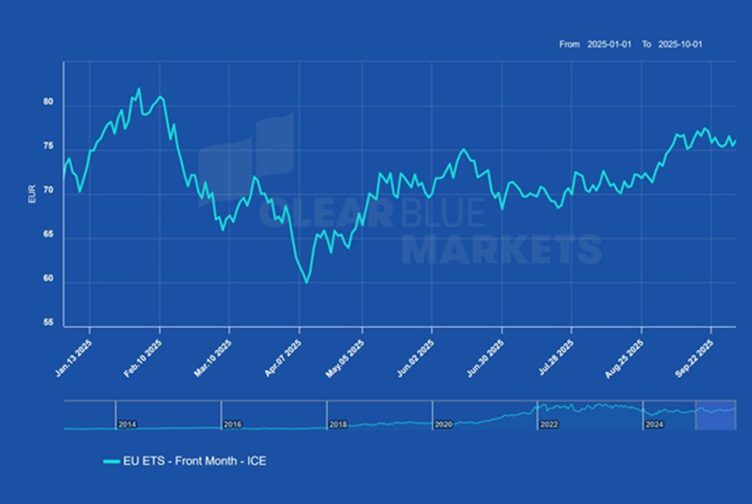
The 30 September 2025 deadline has passed. For the first time, owners and operators of vessels over 5,000 GT that called at EU or EEA ports during 2024 were required to report their CO₂ emissions, purchase, and surrender carbon allowances (EUAs) covering 40% of those emissions under the EU Emissions Trading System (EU ETS).
As expected, the run up to the compliance deadline saw a flurry of last-minute activity. Many shipowners and managers scrambled at the last moment to buy allowances, accepting spot prices the market was offering. Having averaged around EUR 71.60 per EUA from January through to end September 2025, prices rose above EUR 76.00 average per EUA in the final 10 days of the month as demand spiked.
But is this really the most effective way to manage financial exposure to this new regional environmental regulation? Is calling your broker with a last-minute order to “get me the volume at the best price you can” request a sound strategy?
Beyond the long-term goal of transitioning away from fossil fuels, shipping companies must now consider how to strategically manage the cost of compliance in the face of intensifying regulations.
EU ETS Compliance: A New Financial Variable
At IG, we design and implement regional and international compliance strategies tailored for the shipping industry. From emissions accounting and price forecasting to project advisory and carbon trade execution, we support clients across the spectrum—from small operators to large global fleets.
One lesson is clear: a planned, proactive approach to EUA procurement can significantly reduce EU ETS compliance costs. Emissions are no longer just an environmental compliance issue—they have become a material financial variable that needs to be actively managed.
Shipping Is a Price Taker
The shipping sector is essentially a price taker in the EU ETS market. In 2024, verified shipping emissions totalled around 33 million tonnes, a small fraction of the EU ETS market’s 1.1 billion tonnes. Even with the share of covered emissions rising to 70% in 2025, pushing shipping’s EUA demand to around 62 million tonnes, this remains a relatively minor slice of the total.
In other words: even large shipping companies cannot influence the EUA price.
Pricing is driven by:
- EU climate and energy policies
- Auction volumes and EUA supply
- EU industrial output and energy consumption
- Seasonal weather patterns
- Speculative trading, compliance activity and geopolitical developments
Given this, shipping companies must find their edge in timing, strategic planning, and execution efficiency.
Cost Pass-Through Is Not Cost Optimisation
Many shipping companies currently treat EUA costs as pass-through expenses to charterers. While this may be contractually valid, it is not necessarily cost-efficient. Companies often already have a good sense of their EUA exposure for the coming year—so why not take a more measured and strategic approach?
Primary EUA supply is released via weekly auctions feeding through to the secondary markets where most shipping businesses will be purchasing their EUAs. This provides ample opportunity to spread procurement over time. One of our clients, for example, requires over 1 million EUAs annually. Instead of bulk-buying at peak prices in January or September, we execute strategic purchases in blocks across multiple trades over the year.
By anticipating and spreading purchases across the year, we achieved more than EUR 8m of savings, even after factoring in additional execution and trading costs. This approach resulted in significant financial savings, timely compliance and reduced market risk.
Flexibility for Smaller Operators
For operators uncertain about their 2025 EUA needs, IG offers flexible solutions. We can purchase EUAs on a company’s behalf throughout the year, warehouse them, and allocate them as required—ensuring timely compliance, avoiding penalties and potential end-of-year price spikes.
Prepare for a More Complex Compliance Future
Shipping operators are already facing increased compliance complexity. The FuelEU Maritime Regulation is now in force, and the IMO’s Net Zero Framework, expected to be adopted in October, will introduce further financial and operational implications for emissions management, likely from 2028 onwards.
The direction of travel is clear: the cost of emitting is rising, the regulations are becoming more stringent, and financial exposure is growing.
Final Thought: Plan, Be Proactive
The experience of shipping’s first compliance deadline offers a clear lesson: last-minute compliance is expensive compliance. A reactive approach to EUA surrender may have been manageable this year, but it will come with increasingly higher costs as prices rise and regulations intensify.
Taking a planned, data-driven, and strategically executed approach to EUA procurement can help shipping companies reduce costs, minimise volatility, and stay ahead of regulatory developments.
At IG, we help shipping clients shift from a compliance mindset to a strategic emissions management approach. Because in today’s carbon market, emissions aren’t just a number on a report — they’re a line item on your balance sheet.
IG Sustainability
IG guides and supports shipping clients through the complexities of decarbonisation and regulatory compliance. We offer high level advice and insights alongside carbon trade execution services.
The IG sustainability team drives better client outcomes by combining deep shipping expertise with environmental regulatory knowledge.
Our Maritime Carbon Solutions platform allows for both emissions estimates and real-time vessel emissions data.
Our partnership with world leading carbon market experts ClearBlue Markets enables us to secure access to carbon markets, intelligence and optimal pricing.